Table of content
Download
Scan the code to download Arlow and get personalized support for you and your family, all in one place.



The Hidden Cost Sitting in Your Benefits Gap: What Elder Caregiving Is Costing Employers
Quick Takeaways
- Elder caregiving is costing employers an estimated $5,600 per affected employee per year, with almost no dedicated benefit in place to address it (Value Health, 2023).
- Between 23% and 43% of employed adults are juggling caregiving alongside work, and elder caregivers make up 14% of the U.S. workforce (Guardian Life, 2025; HBR, 2025).
- The gap exists because benefits were built for visible, consistent, time-bound life events, and elder caregiving is none of those things.
- The cost shows up as unpredictable absence, presenteeism, and the attrition of experienced mid-career employees.
- Caregiving skills overlap 100% with the top managerial skills in demand across all occupations (MIT Sloan Management Review, 2026).
- Closing the gap is a retention strategy and a productivity lever, not a niche perk, and clinician-led support platforms like Arlow are how employers are doing it.
Every year, organizations make deliberate, well-researched investments in their people. Medical benefits. Retirement plans. Wellness programs. These are not accidents. They are the result of years of data, advocacy, and a growing understanding that employee wellbeing drives organizational performance.
But there is a significant gap in that picture. And it is costing employers an estimated $5,600 per affected employee, per year, quietly, invisibly, and with almost no dedicated support in place to address it (Value Health, 2023).
That gap is elder caregiving, and this article lays out exactly what the elder caregiving benefits gap is, what it is costing you right now, and how to close it through technology and human support.
In short
The elder caregiving benefits gap is the mismatch between what caregiving costs an organization in absence, presenteeism, and turnover and the near-zero benefits investment aimed at it. With up to 43% of employed adults caregiving and a $5,600 annual cost per caregiving employee, closing this gap is one of the highest-return moves available in benefits strategy today.
What Is the Elder Caregiving Benefits Gap?
The elder caregiving benefits gap is a fundamental imbalance in how employers allocate attention and resources. Medical benefits, retirement plans, and wellness programs receive high employer investment, and appropriately so. But caregiving-driven absence, turnover, and lost productivity register an equally high organizational cost with virtually no corresponding investment or support. It is, as HR leaders are now beginning to recognize, hiding in plain sight.
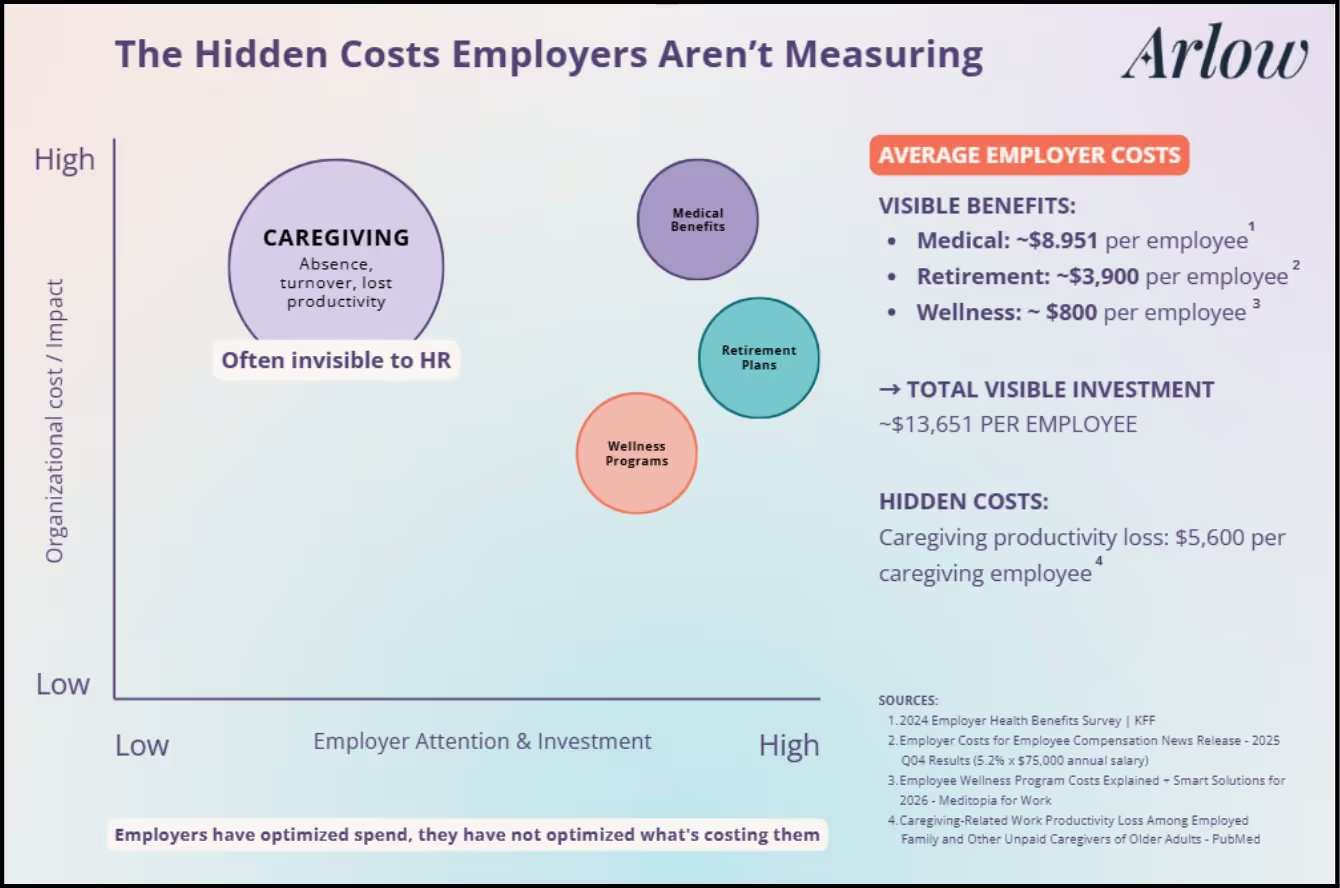
Verdict: Employers have optimized what they spend on. They have not optimized what is costing them.
How Many of Your Employees Are Quietly Caregiving?
Between 23% and 43% of employed adults are currently juggling caregiving responsibilities alongside their work (Guardian Life, 2025). In a workforce of 1,000 employees, that could mean 230 to 430 people quietly managing a second, invisible shift. Elder caregivers alone make up 14% of the U.S. workforce (HBR, 2025), drawn from the 47.8 million unpaid adult family caregivers in the U.S. (Caregiving in the U.S., 2025).
The numbers are striking and highlight the need for strategic attention. 67% of family caregivers report significant difficulty balancing work and caregiving (AARP/S&P Global, 2024)The average caregiver provides about 25 hours of care per week (CaregiverAction.org, 2025), nearly a part-time job on top of a full-time role. The median age of an elder caregiver is 50.6 years (National Alliance for Caregiving, 2025), exactly the demographic holding your deepest institutional knowledge. And three in five caregivers are women (Caregiver Action Network, 2025), which makes elder care a gender equity and talent retention issue as well as a productivity one.
Why Is Elder Caregiving Not Like Other Life Events?
Because it is unpredictable, open-ended, and invisible. Employers have built robust support systems around predictable life stages such as parental leave, childcare FSAs, and FMLA guidance because those needs are visible, consistent, and time bound. Elder caregiving is none of those things.
The caregiving journey for an aging parent or spouse does not follow a schedule. There is no developmental milestone chart. Instead, there are unexpected emergency department visits, shifting cognitive and physical needs, medication management demands, and care transitions that can occur at any time and often without warning. The result is a pattern of unpredictable absences, reduced availability, and presenteeism. Presenteeism is the productivity lost when an employee is physically present but their cognitive and emotional bandwidth has been substantially redirected, and for caregivers it is often the largest share of the cost.
Consider what caregivers themselves report:
- 64% experience significant emotional stress (Caregiving in the U.S., 2025)
- 45% report physical strain (Caregiving in the U.S., 2025)
- Nearly 35% of caregivers ages 45 to 64 are managing two or more chronic conditions of their own (CDC, 2018)
- 1 in 5 rate their own health as fair or poor (Caregiving in the U.S., 2025)
- Caregivers spend an average of 26% of their personal income on care-related costs (Kiplinger, 2023)
A decline in a caregiving employee's health does not stay personal. It becomes a benefits cost layered on top of a productivity cost.
<white>
“80% of working caregivers say their employer is more understanding of childcare than eldercare. That perception reflects a real gap in employer strategy.”
AARP/S&P Global, 2024
</white>
What Is Caregiving Actually Costing You in Productivity and Retention?
An estimated $5,600 per caregiving employee per year in combined absenteeism and presenteeism (Value Health, 2023). Working caregivers miss an average of 1.2 workdays per month (SHRM, 2025), roughly $17.5 billion in lost wages nationally each month, and 42% report measurable career challenges due to caregiving demands (SHRM, 2025).
Beyond daily productivity, the AARP/S&P Global workforce research (2024) shows caregiving reshaping career trajectories in ways that hit talent pipelines directly:
Verdict: Each row is a recurring organizational cost: lost institutional knowledge, recruiting and onboarding expense, and the departure of experienced mid-career employees, with replacement running 50% to 200% of an annual salary.
Why Are Your Caregiving Employees Among Your Most Valuable?
Because caregiving builds the exact capabilities employers struggle to develop. What is often missing from the cost conversation is this: an employee supporting an aging parent, coordinating care, and navigating a complex healthcare system is not just dealing with a personal challenge. They are actively developing a set of capabilities that research shows are among the most valuable and difficult to cultivate.
This shift in perspective is critical, and the data supporting it is strong.
<yellow>
MIT Sloan Management Review (March 2026): Caregiving skills achieved 100% overlap with the top managerial skills in demand across all occupations: adaptability, problem-solving, decision making, and leadership.
</yellow>
When researchers at MIT Sloan mapped caregiving competencies against the U.S. Bureau of Labor Statistics' 17 core workplace skills, they found that caregiving skills covered 76.5% of all workforce skills valued by employers. For management roles specifically, caregiving skills had 100% coverage across all leadership competencies, including adaptability, problem-solving, decision-making, and leadership itself.
How Does Arlow Close the Caregiving Gap?
By giving working caregivers the same quality of structured, expert support that employees receive for any other major health or life transition. Arlow is intentionally designed for the elder caregiving journey, bringing together the clinical expertise, care coordination tools, and empathetic guidance that caregivers need to manage this chapter without sacrificing their careers or their own wellbeing.
For employers, Arlow operates as a strategic benefit, embedded in your existing workforce support framework and designed to address the caregiving gap before it becomes a retention problem, a productivity loss, or a benefits cost.
What Arlow offers your workforce:
- Human support and 24/7 app navigation through the eldercare journey, from early-stage support needs through complex care transitions
- Personalized care planning tools that help caregivers organize, prioritize, and take action, reducing the cognitive burden that spills into the workplace
- Access to guidance on care transitions, resource support, and logistical needs often encountered during caregiving
- Caregiver health and wellbeing check-ins, reminders, and resources that support the mental and physical resilience of the caregiver themselves
- Employer-facing insights that help HR and benefits leaders understand caregiving impact and respond proactively
Caregiving is not a wellness trend. It is a complex, multi-year responsibility that intersects health, finances, family dynamics, and work performance in ways that require real expertise to navigate well.
Arlow approaches this with deep empathy for the caregiver. These are your most committed employees, carrying an extraordinary load with very little formal support. They are asking to be seen and given the tools to manage this chapter with greater confidence and control. Employers
The Strategic Opportunity
Caregiving support is a core retention strategy, a productivity lever, a talent development recognition, and increasingly, a signal of organizational values that top talent notices.
Your caregiving employees are not liabilities to be managed. They are among the most experienced, adaptable, and emotionally intelligent people in your organization. The question is whether you are investing in keeping them.
The data is clear. The cost is real. The gap is measurable. And the opportunity to close it, for your employees and for your organization, is available now.
<lilac>
Learn how Arlow can help your organization build a caregiving-ready workforce. Visit www.arlow.ai to schedule a consultation.
</lilac>
Frequently Asked Questions